|
B.Sc in Chemistry equips students with a comprehensive understanding of chemical principles and analytical techniques. Analyzing chemical compounds is a fundamental aspect of chemistry, allowing scientists to understand the composition, structure, and properties of substances. Here, we explore some of the top methods used to analyze chemical compounds, an integral part of the B.Sc in Chemistry Courses Syllabus. 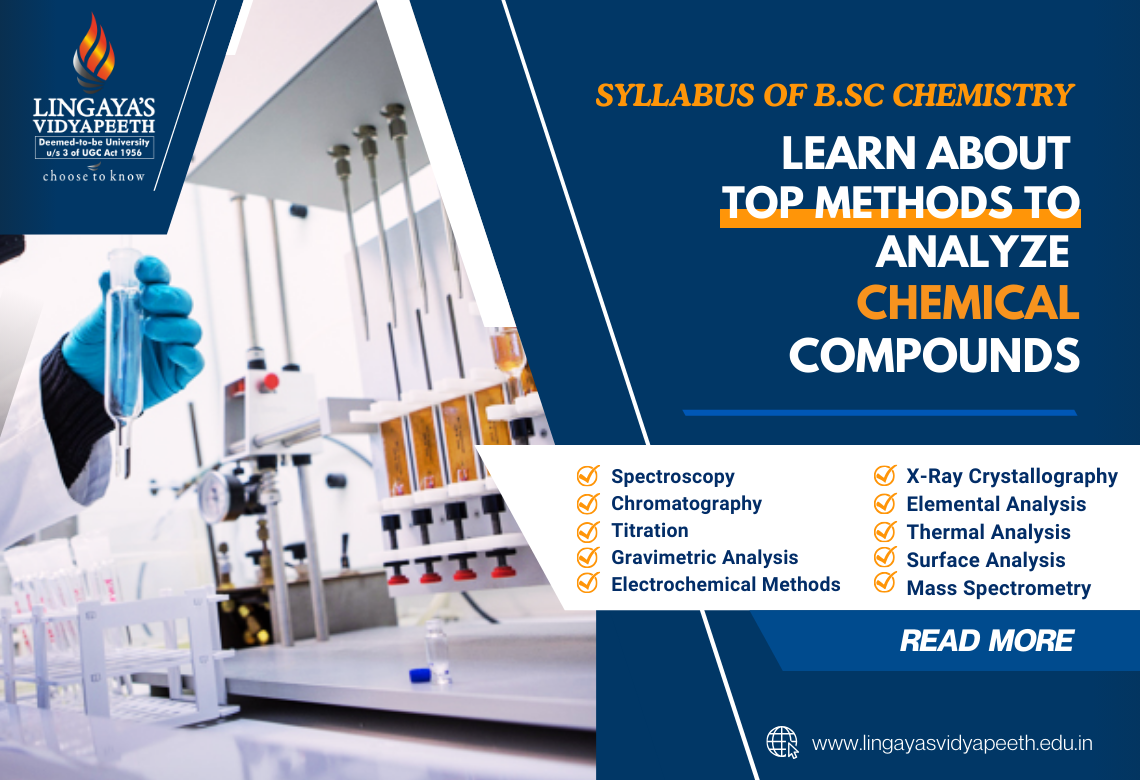 1. Spectroscopy:
Spectroscopic techniques involve studying the interaction of matter with electromagnetic radiation. UV-Visible, Infrared (IR), Nuclear Magnetic Resonance (NMR), and Mass Spectrometry are fundamental tools for compound analysis. 2. Chromatography: Chromatographic techniques separate complex mixtures based on their affinities to a stationary phase. Gas Chromatography (GC) and High-Performance Liquid Chromatography (HPLC) play pivotal roles in compound analysis. 3. Titration: Titration is a precise method for determining the concentration of a substance by adding a known solution (titrant) to a solution with an unknown concentration (analyte). It is a cornerstone in quantitative chemical analysis. 4. Gravimetric Analysis: Gravimetric analysis quantifies a substance by weighing the precipitate formed during a chemical reaction. It is particularly valuable in determining the composition of metals and minerals. 5. Electrochemical Methods: These methods study chemical reactions involving the transfer of electrons. Techniques like potentiometry, voltammetry, and coulometry are essential for redox reactions and concentration determinations. 6. X-Ray Crystallography: X-ray crystallography provides precise information on molecular structures by analyzing X-ray diffraction patterns. It's crucial for understanding the spatial arrangement of atoms in compounds. Digital X-Rays: Recent Development in Radiography 7. Elemental Analysis: Elemental analysis determines the relative abundance of elements in a compound. Techniques like Inductively Coupled Plasma (ICP) and Atomic Absorption Spectroscopy (AAS) are employed for this purpose. 8. Thermal Analysis: Thermal analysis studies how materials respond to changes in temperature. Techniques like Differential Scanning Calorimetry (DSC) and Thermogravimetric Analysis (TGA) help identify phase transitions and decomposition temperatures. 9. Surface Analysis Techniques: Techniques like Scanning Electron Microscopy (SEM) and X-ray Photoelectron Spectroscopy (XPS) are invaluable for studying the surface composition and structure of materials. These methods and techniques form the backbone of modern chemical analysis, empowering scientists to unlock the secrets of matter. The Best College in Delhi NCR for B.Sc Chemistry is Lingaya's Vidyapeeth, where students gain a comprehensive understanding of chemical concepts and honing their ability to tackle complex challenges. The B.Sc Chemistry syllabus encompasses a wide array of analytical techniques, equipping students with the skills to analyze and understand chemical compounds. Mastery of these methods empowers chemists to make significant contributions in research, industry, and various other fields.
0 Comments
|
Growth GuideElevate your education journey with Lingaya's Vidyapeeth to Make Bright Future. Look at here tips, strategies, and inspiration for academic excellence.
|
 RSS Feed
